
A bath mat is the only textile in a house that is routinely wet and routinely ignored. It sits in the dampest room, soaks up soapy water and skin cells, then goes back on the floor — often still damp. That is the whole hygiene story, and it is why the familiar answers miss it: "buy diatomaceous earth" and "buy an antibacterial mat" are both answers about labels, not about what happens between uses.
Table of Contents:
What makes a bath mat sanitary? Dry time, not the label
What is the most sanitary type of bath mat? A thin, low-pile bath mat made from a synthetic fibre — polyester or microfibre — with a rubber or TPR backing, washed at 60 °C and hung so that both faces dry. The fibre and the thin pile matter because both shorten how long the mat stays wet; the washing and the drying do the actual sanitising.
The reasoning is simple. Micro-organisms need moisture, and the EPA's own mould guidance is blunt about it: mould grows on almost any surface as long as moisture and oxygen are present. A mat that is dry for twenty hours a day is a poor habitat; a mat that is damp for twenty hours a day is a good one, whatever it is made of.
So three numbers decide the outcome, and most buying guides only discuss the first:
- How much water the fibre itself holds — a measurable textile property called moisture regain, which varies by a factor of forty between fibres.
- How much water the construction traps — a mat is mostly air, and pile height and tuft density decide how much water sits in that air and between the fibres.
- How completely both can be removed — can the mat take a hot machine wash, and will it dry on both faces, or does it stay folded and damp against the tile?
Get all three right and the mat stays hygienic with little effort. Get the first right and the other two wrong — which is what happens with most "hygienic" mats on the market — and you are back to washing a damp mat every other day.
If your mat sits near a doorway rather than beside the tub, the clearance logic in our guide to door mat thickness applies: a mat that never fully clears the floor plane never fully dries.
Which bath mat material holds the least water
Moisture regain is how the textile industry describes the water a fibre absorbs from the air. It is measured at a standard atmosphere of 20 °C and 65% relative humidity, as a percentage of the fibre's dry weight, and normalised in standards such as ASTM D1909.
| Fibre | Standard moisture regain | What it means on a bathroom floor |
|---|---|---|
| Polypropylene | 0.04% | Effectively water-repellent; sheds rather than absorbs |
| Polyester | 0.4% | Holds almost no water in the fibre itself — the basis of every fast-drying mat |
| Acrylic | 1.5% | Low uptake, but pills and mats with wear |
| Nylon | 4.5% | Ten times polyester; slower to release what it takes on |
| Cotton | 8.5% | Twenty times polyester; pleasant and cool, but every gram of that water must evaporate |
| Viscose / rayon | 11% | Behaves like cotton and loses strength when wet |
| Linen | 12% | Fast-drying for a plant fibre, but creases and stiffens |
| Wool | 13.6–16% | Highest uptake of any common mat fibre; slowest to dry |
Read that column as a drying forecast, not a hygiene score. Polyester holds roughly one twentieth of the water cotton holds in the same fibre mass, and one fortieth of what wool holds. On the fibre question alone, a synthetic mat starts with an advantage no laundering convenience can close.

Why a plush tufted bath mat still stays damp
Here is the part the fibre table hides. Moisture regain describes the fibre; a bath mat is mostly void. In a deep tuft, water does not sit inside the polyester — it sits in the gaps between the fibres, held by capillary action, and there is a great deal of gap.
That is why a thick polyester mat can hold more total water than a thin cotton one even though its fibre is hydrophobic. The fibre decides how much water clings to the fibre; the construction decides how much the mat is holding when you step off it. Both must evaporate, and evaporation needs air moving over surface area — which a dense, deep pile has very little of.
You can test this on your own mat with no equipment. Weigh it dry, step out of the shower onto it, weigh it again an hour later. The gap between those numbers is the water you are asking to leave the room — and the longer it takes, the longer the mat is a wet environment rather than a dry one.
Bath mat types compared by dry time and washability
The table below runs the six common constructions through the same three questions. Moisture regain is measured data; dry times are honest estimates for a mat hung in a normally ventilated bathroom at around 20 °C, not laboratory results. (For fit and placement rather than drying, see our guide to buying bathroom rugs.)
| Bath mat type | Construction | Water held after use | Typical dry time (hung) | 60 °C machine wash | Hygiene verdict |
|---|---|---|---|---|---|
| Microfibre / flat-woven synthetic | Polyester, low pile | Low | 2–4 hours | Yes | Best overall — dries fastest while still being washable |
| Thin cotton terry or waffle | Cotton, flat | Moderate | 4–8 hours | Yes, expect shrinkage | Good, if you accept the slower dry |
| Plush tufted polyester | Polyester, deep tuft | High | 6–12 hours | Yes, low tumble | Good with discipline — needs a full dry, see below |
| Rubber or PVC mat | No textile pile | None held | Minutes | Rinse in place | Good if hung; mould colonises the underside and cups |
| Chenille or memory foam | Deep pile over foam core | Very high | 12–24 hours | Foam degrades | Weakest for hygiene — slowest to dry, hardest to dry through |
| Diatomaceous earth board | Rigid mineral | None held | Minutes | No | Wins dry time, loses cleanability |
Two entries there are counter-intuitive. The rubber mat never gets damp, but it is not automatically the most hygienic: the water it sheds goes underneath it and sits against the tile in the dark. And the mat that dries fastest of all is the one you can least easily clean.
Diatomaceous earth bath mats: fastest dry, hardest to clean
Are diatomaceous earth bath mats more hygienic? They dry faster than any fabric mat and never hold a damp pile, so on dry time alone they win. They lose on the other half of hygiene: the board cannot be machine washed, it cracks if it is dropped, and the surface has to be sanded back once it stops absorbing, so the dirt and skin cells that collect on it are harder to remove.
Diatomite is a porous, siliceous rock, and a mat made from it draws surface water into the board and lets it evaporate from a much larger area than a puddle would offer. That is why these mats are the standard recommendation for this query, and the mechanism is genuinely good. The trade-off is that hygiene has a cleaning half as well as a drying half: a board that must be sanded to restore its absorbency and cannot go in a washing machine accumulates a film no amount of drying removes. For a single adult in a dry bathroom they are excellent; for a family with a shared bathroom, a washable mat is usually the more hygienic object by the end of the month.

Where our own plush bath mat sits on this test
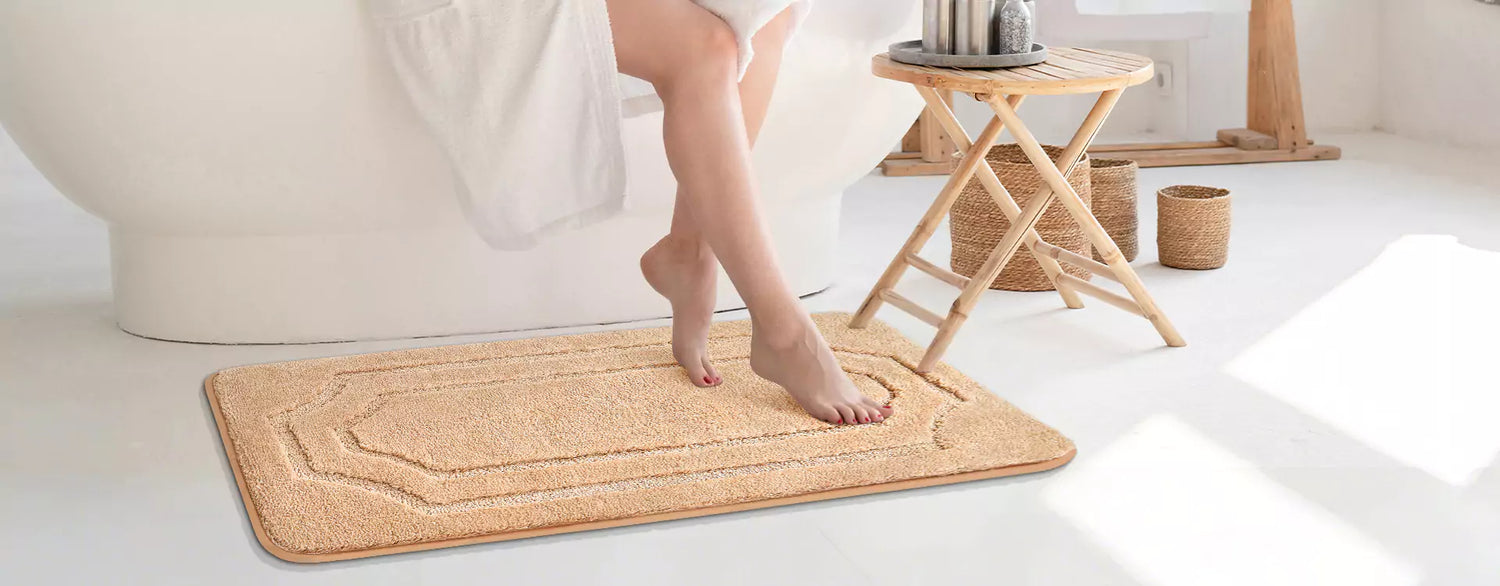
We should be straightforward about our own product, because it lands exactly where this analysis predicts. The Double Framed Tufted Bath Mats are 100% polyester with a 1.3 in (38 mm) tufted pile and a TPR anti-skid backing, and they are machine washable.
- Fibre: polyester, at 0.4% moisture regain. This is the right side of the fibre test, and it is a deliberate material choice rather than a happy accident.
- Construction: a 38 mm tuft is at the demanding end of the structure test. It will hold more water and take longer to dry than a flat mat, and no amount of fibre chemistry changes that.
- Removal: machine washable, but our product page does not state a wash temperature. Until it does, follow the care label rather than assuming 60 °C.
We sell a comfortable, plush, polyester mat, and it stays hygienic if — and only if — you dry it completely and wash it hot on a schedule. Buy it for the feel and run it as the next two sections describe. If hygiene is your only criterion, a thin low-pile synthetic mat is the better object, and we would rather say so here than have you work it out from the reviews.
Why an "antibacterial bath mat" claim is a compliance trap
Are antibacterial bath mats worth buying? Mostly no. A textile treated with an antimicrobial preservative may not claim to protect you from germs unless the product is registered as a pesticide, and the EPA states that no scientific evidence exists that these treated products prevent the spread of germs to people. A mat sold on an antibacterial label is usually selling a claim it is not allowed to make.
The EPA's guidance on consumer products treated with pesticides sets out the rule. A "treated article" is an item treated with an antimicrobial pesticide to protect the item itself, and the exemption from pesticide registration covers only that protective purpose — explicitly not public-health uses. A qualifying product may say that antimicrobial properties are built in to inhibit bacteria that may affect the product, but the same label must then state that those properties "do not protect users or others against bacteria, viruses, germs, or other disease organisms," and must advise washing before and after use.
If a mat claims to work against named organisms such as E. coli or S. aureus, it has made a public-health claim and must be registered as a pesticide. EPA also notes that its policy rests on the finding that no scientific evidence exists that these products prevent the spread of germs in humans, and that people who believe a product is self-sanitising "may become lax in their hygiene practices."
That is the practical takeaway. A label implying the mat cleans itself is either a registered pesticide or an overclaim, and either way it says nothing about whether the thing in your bathroom will be dry by tonight. Ignore the word antibacterial and ask the two questions that map to real outcomes: can this mat be washed at 60 °C, and will it dry on both faces?
How to keep a plush bath mat sanitary: the weekly routine
How often should you wash a bath mat? Wash a bath mat at least once a week in a household of two or more people who shower daily, and at 60 °C when the care label allows it. A single-person household with a working extractor fan can stretch to every ten days to two weeks, but any mat that has stayed damp for more than 24 hours should be washed regardless of the calendar.
| Household | Minimum wash frequency | Why |
|---|---|---|
| Two or more people showering daily | Weekly, or every 3–4 days in a humid climate | Water load and skin cells build up faster than the mat can shed them |
| One person, extractor fan used, mat hung after every use | Every 10–14 days | The mat is dry most of the day, so the growth window is short |
| No window and no working fan | Every 2–3 days | The room stays near saturation and the mat rarely dries through |
| Anyone with athlete's foot, a skin infection or a weakened immune system | After each use, or a personal mat | Fungal spores transfer to the pile from feet and survive drying |
Between washes, the highest-value habit is not washing — it is hanging. Drape the mat over the tub rim or a rail so both faces see air, and lift it off a wet tile once a day so the floor underneath can dry too. A mat left crumpled on a damp floor stays wet in the same places every time, which is why the middle of a plush mat smells long before the edges do.
How to wash a bath mat at 60 °C without wrecking it
NHS home hygiene guidance is clear that laundering fabrics at 60 °C or above destroys most germs, and that lower-temperature washes need a laundry disinfectant to compensate. A bath mat belongs in that category — a shared textile that gets wet daily, like a towel.
- Wash it with towels rather than a full load of clothes. A 38 mm tuft sheds lint, and an overloaded drum never reaches temperature properly.
- Use normal detergent and skip fabric softener. Softener coats the fibres — the one property you do not want on a mat whose job is to take water off your feet.
- If the care label stops you short of 60 °C, wash at the highest temperature it allows and add a laundry disinfectant rather than guessing.
- Tumble on low or air-dry. High heat warps a TPR backing, and a mat that will not lie flat is a trip hazard, not a hygiene upgrade.
- Dry it completely before it goes back down. A mat that returns warm and slightly damp simply restarts the clock.
One caveat most care guides leave out: the washing machine is not sterile. Research on domestic machines has found persistent bacterial biofilm in detergent drawers and door seals, so a mat washed in a machine that is never itself cleaned can pick up organisms on the way out. Run a hot maintenance cycle monthly, and if your washer smells empty, clean it before you trust it with a mat.
Sources and Verification
- Moisture regain values — standard textile values at 20 °C / 65% relative humidity, normalised in ASTM D1909 and reproduced in standard textile handbooks (e.g. Textile Calculation, 2023, and Medical Textile Materials, 2016). Retrieved 13 October 2026.
- EPA, "Consumer Products Treated with Pesticides." Retrieved 13 October 2026. Source of the treated-articles exemption, the permitted preservative wording, the requirement that products naming organisms such as E. coli or S. aureus be registered as pesticides, and the statement that no scientific evidence exists that treated products prevent the spread of germs in humans.
- EPA, "A Brief Guide to Mold, Moisture and Your Home." Retrieved 13 October 2026. Basis for the point that mould grows wherever moisture and oxygen are present — the reason dry time is the controlling variable.
- NHS home hygiene guidance on laundry (60 °C). Retrieved 13 October 2026. Basis for washing at 60 °C or above to destroy most germs, and for the note about lower-temperature washes and disinfectants.
- Published research on domestic washing machine biofilm. Retrieved 13 October 2026. Basis for the caveat about machines harbouring persistent bacterial biofilm in seals and detergent drawers.
- Our own product specifications — pile height (1.3 in / 38 mm), fibre (100% polyester), backing (TPR) and washability taken from the BEQHAUSE Double Framed Tufted Bath Mats product page, retrieved 13 October 2026.
Verification note: the moisture-regain table is measured data and will not change. The dry-time column is an informed estimate at room temperature and is labelled as such in the table — we have not run timed drying tests on every construction, and we say so rather than presenting the numbers as measurements.