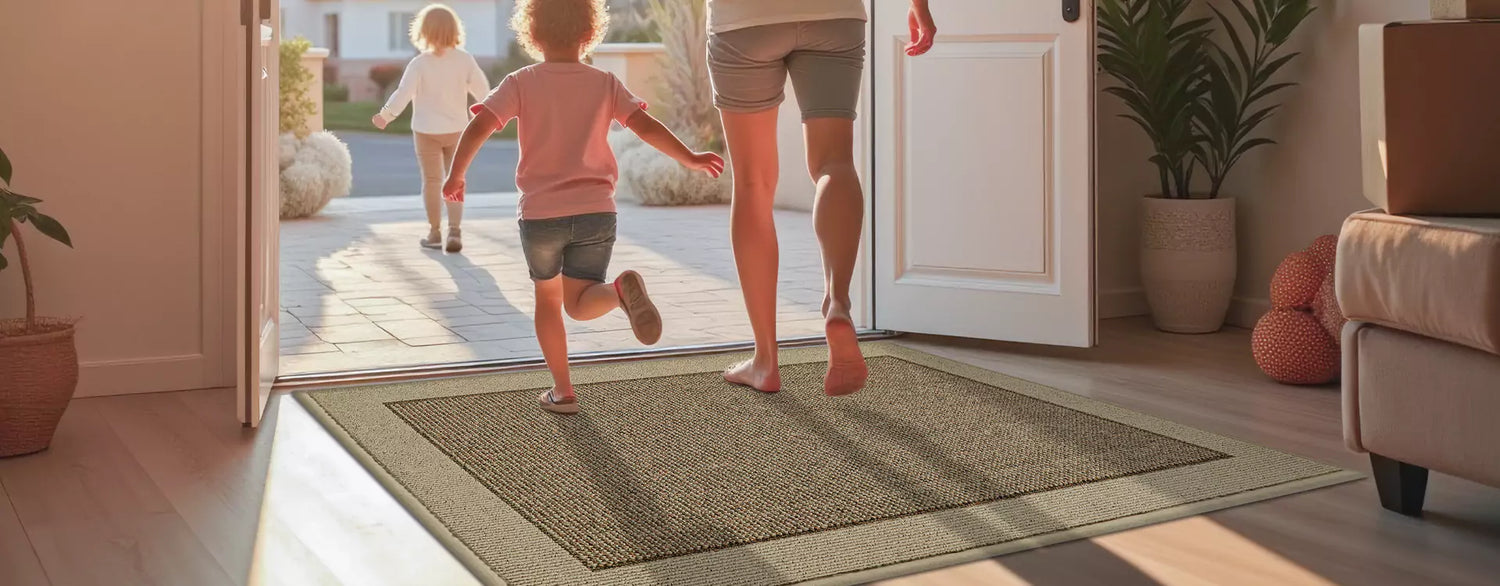


Your entryway doormat does more physical work than almost anything else in your home. It intercepts rainwater, mud, sand, grit, road salt, pet mess and the abrasion of every footstep before any of it reaches your floor. A doormat is not decor that happens to be on the floor. It is a small, consumable filtration system that you stand on.
That framing matters, because it tells you what to evaluate. A doormat has to scrape, wick, drain, stay flat, stay put and clear your door — and it has a finite capacity for soil and water. When it fills up, it stops working. Everything below is about measurable versions of those jobs.
What independent testers actually found: Better Homes & Gardens tested doormats in their editors' homes for six months, through sun, rain, dirty dog paws, teenagers and New York City street filth. The Spruce has tested 25 mats across the United States, in some cases for two years or more. Their combined conclusion is not glamorous: the most reliable doormat for most entryways is a dense synthetic-fibre mat — polypropylene or recycled polyester — with a textured scraping surface, a rubber or TPR backing, and a thickness low enough to clear your door.
This guide goes further than repeating that. It explains the material science behind it, gives you the exact specifications to ask a manufacturer for, gives you a 20-minute test you can run on any mat before you buy a second one, and then tells you plainly where our own products fit and where they do not.

Table of Contents:
- Best Doormat for Most Entryways
- Best Budget Doormat for Entryways
- Best Coir Doormat for Mud
- Best Rubber Doormat for Rain
- Best Indoor Doormat for Entryways
- Doormat Specifications: What Every Number Actually Means
- Doormat Material Comparison
- Doormat Lifespan and Real Cost Per Year
- How to Choose the Right Doormat Size
- How to Test a Doormat Yourself in 20 Minutes
- Simple Doormat Tips That Actually Help
- Where BEQHAUSE Doormats Fit
- Sources and Verification
Best Doormat for Most Entryways
For most homes, buy a dense polypropylene or recycled-polyester mat with a raised or embossed texture and a TPR or rubber backing, in the largest size your door will clear.
The example most often cited by testers is the L.L.Bean Everyspace Recycled Waterhog Doormat, which Better Homes & Gardens reports holds up to 1.5 gallons of water per square yard in its raised border. That is a real, meaningful number: it tells you the mat is designed to store water inside itself rather than pass it to your floor. BHG also found it showed no fading and no fibre shedding after six months of use. The Spruce's testers noted Waterhog-style mats are easy to shake clean but "can take longer to dry—often a full one to two days after being rained on."
Why synthetic fibre wins on water, in one material fact
This is the part most doormat articles skip, and it explains almost every practical difference between mat types.
Fibres are rated by moisture regain — how much water they absorb into the fibre itself, as a percentage of their own dry weight:
| Fibre | Typical moisture regain | What it means on a doormat |
|---|---|---|
| Polypropylene (olefin) | 0.01–0.1% | Effectively waterproof. Water sits in the gaps between yarns, not inside them |
| Polyester | ~0.2–0.8% | Also strongly water-repellent, and more fade-resistant than PP |
| Nylon | ~3.5–5% | Absorbs some water; slower to dry, better abrasion resistance |
| Cotton | ~7–8.5% | Holds water inside the fibre; stays damp for hours |
| Coir (coconut husk) | Lignocellulosic; takes water into the fibre wall | Stays damp, can support mildew if left wet |
A polypropylene mat is not "absorbent" in the way a towel is. It works by capillary storage — water is trapped in the void space between densely packed yarns, held by surface tension, and released by airflow. That is why a PP mat can hold a large volume of water yet dry in a fraction of the time of a coir or cotton mat, and why it does not develop the damp, musty smell that natural-fibre mats can.
Practical consequence: on a PP mat, water removal is a drying problem (airflow). On a coir or cotton mat, it is an evaporation problem that takes much longer, and the mat stays wetter in the meantime.
Also check the edge construction
A doormat fails at its edges first. Ask whether the border is stitched, bound or fused, and whether the backing is laminated or mechanically bonded. A fused edge that delaminates in year two is the most common complaint pattern in this category, and it is invisible in product photos.
Best Budget Doormat for Entryways
A cheap doormat can work well. Feature priority, in order:
- Low profile (≤10 mm / 0.4 in) so it clears the door
- Textured face with real relief, not a printed image
- Non-slip backing — TPR or natural rubber, not a bare fabric back
- Size, which is where budget mats fail most often
Better Homes & Gardens rated the IKEA TRIABO as its best budget pick — sturdy, quick-drying, easy to clean. It is 99.5% coir with 0.5% polyethylene at 1.4 × 2.4 ft, and BHG notes it does shed a little, which is normal for coir. Its real limitation is the same as every budget mat: a small mat gives each shoe fewer square inches of contact, and contact area is the entire mechanism.
Interior designer Alexandra Cooper (Planner 5D) makes the point bluntly: "A mat that is too small in comparison to the door is not practical and makes the overall look feel unfinished. Try and make the mat occupy the full length of the door."
Where our own budget option sits: the BEQHAUSE Solid Color Dirt Trapper Plain Doormat starts at $22.99 across sizes from 17"×30" up to 3'×5", in dense polypropylene, 0.4 in thick, with a TPR backing. It is built to the feature list above rather than to a low price alone. We are not comparing it to a Waterhog here, because it does not have a water reservoir — a point we return to honestly further down.
Best Coir Doormat for Mud
Coir is the fibre from coconut husk: stiff, bristly, and genuinely excellent at one job — scrubbing dry and semi-dry soil off a sole. It is the best pure scraper material in common use.
Two test-derived cautions, both from The Spruce's trials:
- Texture versus skin. The Spruce's testing team noted the rough surface of thick coir "isn't ideal if you have crawling toddlers, since the texture can chafe or cut bare skin." That is an under-reported downside for homes with babies.
- Wet behaviour. Coir is a lignocellulosic fibre that takes water into the fibre wall, so it holds moisture longer than rubber or synthetics and can shed and fade in sustained rain.
What coir gets right: The Spruce's overall best outdoor pick was the Entryways Coir Rope Knot Doormat — tight, thick coir that traps dirt, leaves and mud, and in their testing it did not slide despite having no rubber backing. BHG's most-durable coir pick, the Grandin Road Monogrammed Doormat (100% coir, 7 lb), showed no wear, no shedding and no fading after six months.
Verdict: coir belongs on a covered porch as the outside scraper. It is not a year-round exposed-weather mat.

Best Rubber Doormat for Rain
In sustained rain, you want a mat that does not try to hold water at all. Rubber matting drains, rinses and does not rot.
The Spruce found the Calloway Mills Gatsby Rubber Door Mat stays heavy and in place even when wet, with a coating that lets it dry quickly — but their testers also recorded two real trade-offs: it "did show more signs of wear than other rubber mats," and "because of the gaps in the design, mud can be hard to clean and remove from the crevices." That is the honest version of a rubber recommendation: excellent drainage, worse cleaning.
At the heavy-duty end, the M+A Matting WaterHog Diamond is about half an inch thick and, in The Spruce's testing, stayed put through 30–40 mph wind gusts with corners that never curled or bent.
Open-grid vs. solid backing: an open grid drains and lets sand fall through, which is what you want at a coastal or driveway entrance. A solid backing stops water at the mat instead, which means the mat itself becomes the reservoir and needs air. Match this to whether your doorway is covered.
Our position: BEQHAUSE does not currently make an open-grid rubber mat or a heavy water-reservoir mat. If your doorway is fully exposed to storms and standing water, buy one that is built for it.
Best Indoor Doormat for Entryways
The indoor mat has a different job from the outdoor one. It should be thinner, denser and drier — it is catching the moisture and fine grit that got past the scraper, not the bulk of it.
The benchmark test result here: Better Homes & Gardens reported the Porte + Hall Insider Doormat absorbed water well, dried in about 30 minutes, and did not seep through to hardwood during testing. That combination — fast dry and no strike-through — is exactly what an indoor entry mat should be measured on, and it is why a thin, dense, PP-backed mat beats a plush decorative one at the same spot. It retails around $69, often discounted to $56.
Specifications to target for an indoor entry mat:
| Spec | Target | Why |
|---|---|---|
| Thickness | ≤ 10 mm / 0.4 in | Clears doors, does not foul the sweep |
| Surface fibre | Polypropylene or polyester | Near-zero moisture regain, dries fast |
| Backing | TPR or natural rubber | Grip on tile and hardwood; no plasticiser migration |
| Machine washability | Yes, cold, mild cycle | The only way to remove salts and oils that vacuuming leaves behind |
| Edge | Bound or stitched | Delamination is the first failure point |
Our published specification for this job: the BEQHAUSE Solid Colored Bordered Non-Slip Washable Entrance Carpet is dense polypropylene, 0.4 in (about 10 mm) thick, with a TPR (thermoplastic rubber) backing, from $24.99.
A note on TPR, because it is often glossed over: TPR is a rubbery block copolymer that does not require plasticiser additives to stay flexible. Rigid PVC backings do — historically phthalate plasticisers — which is why PVC is the backing type with a Proposition 65 dimension. TPR also stays flexible at lower temperatures than PVC, which matters for a mat sitting on a cold concrete slab in winter. That is a genuine materials reason to prefer TPR, not a marketing one.

Doormat Material Comparison
This is the section that turns a "best of" list into something you can use to interrogate any product page, including ours.
| Specification | What it measures | Target to ask for | Why it matters |
|---|---|---|---|
| Thickness | Door clearance | ≤ 10 mm / 0.4 in indoors | A mat that catches the door sweep gets dragged, curled and tripped on |
| Fibre type | Moisture regain | PP or recycled PET | Determines drying time, mildew risk and fade resistance |
| Yarn density | Scraping edges per unit area | Ask for GSM or pile weight; "dense" is not a spec | More fibre edges per cm² = more soil removed per step |
| Backing | Grip chemistry | TPR, nitrile or natural rubber | Wet and dry traction; avoids plasticiser concerns |
| Abrasion resistance | Rubs to visible wear (Martindale, ASTM D4966 / ISO 12947) | 20,000+ rubs for light domestic use, 40,000+ for heavy traffic | The closest proxy for how the mat looks in year two |
| Lightfastness | Colour fade (AATCC 16, graded 1–5) | Grade 4 or above at 40–60 AFU | Grade 4+ is the common minimum for upholstery textiles; below that, sun-facing mats blush and grey |
| Slip resistance | Ramp angle or coefficient of friction | Ask for a ramp angle under DIN 51130 (R-class), or a stated incline-test result | The single most safety-relevant number for a stair-adjacent or wet mat |
| Flammability | US federal requirement | Compliance with 16 CFR 1630 / 1631 | Legally required for carpets and rugs sold in the US |
| Fibre content and care label | US federal requirement | Textile Fiber Products Identification Act; FTC Care Labeling Rule (16 CFR 423) | Fibre content and care instructions must be disclosed by law. If a seller will not tell you the fibre, that is your answer |
Two things follow from that table. First, the legally required disclosures on a US rug label are the cheapest place to start your due diligence — fibre content, country of origin and care instructions are mandatory, and a serious brand will also have flammability compliance for the size class it sells. Second, abrasion, lightfastness and slip numbers are not mandatory, which is exactly why they separate a manufacturer that tests from one that does not. Ask. A brand that cannot quote any of the three is telling you something useful.
What we publish, and what we do not yet publish. We publish fibre type, thickness, backing material, dimensions, price and care instructions, because those are our manufacturing specifications and we can stand behind them exactly. We do not currently publish third-party abrasion, lightfastness or ramp-slip test results for our doormat range. We are running the protocol in the next section across our SKUs and will publish the numbers and photographs here when they are complete. Until that table appears, treat every BEQHAUSE performance claim in this article as a manufacturer specification, not an independent test result. We would rather state that clearly than imply evidence we do not have.
Doormat Material Comparison
| Doormat type | Best for | Main strength | Watch out for | Typical water behaviour |
|---|---|---|---|---|
| Recycled synthetic / Waterhog-style | Busy, covered entryways | Large water storage; BHG measured up to 1.5 gal per sq yd on the Waterhog border | Higher cost; Spruce testers found rubber-backed mats can take 1–2 days to dry after rain | Stores then releases; some mats hold water a long time |
| Coir | Covered porches, dry mud scraping | Best mechanical scraping of dry soil | Sheds, fades, stays damp; rough on bare skin (The Spruce) | Slow; fibre absorbs into the wall |
| Rubber grid | Rain, snow, exposed doorways | Drains immediately, stays put, weighs enough not to shift | Mud and leaves collect in the openings | Passes water through — needs a drain path |
| Low-profile indoor fabric (PP / PET) | Apartments, indoor entry zones | Fits under doors, dries fast, machine washable | Not for heavy outdoor mud | Capillary storage; dries quickly with airflow |
| Teak or wood slat | Patios, pool decks, sand | Water and sand fall through; sand brushes off easily | Less absorbent, heavy, taller — The Spruce noted it will not clear every doorway | Passes through entirely |
What the independent testers measured, and what they did not
Worth being precise here, because "tested" gets used loosely.
Better Homes & Gardens (six months, editors' homes, published/updated 4 August 2026) measured absorption level, drying time, slip resistance, backing, size, quality, style, value, shedding and weather resistance. One mat dried in about 30 minutes; one was weighed at 7 lb; one water capacity figure was quantified at 1.5 gal per square yard. The rest of the reporting is qualitative.
The Spruce (25 mats, tested across the US, updated 2 February 2026) tracked quality, effectiveness, durability and value, and their testers keep mats in service for a year or more. They report specific observations — sustained 30–40 mph gusts, two-year service life on one mat, a day or two to dry on others — but not lab-standard numeric scores.
So: neither publication is a laboratory. Both are long-duration, real-world, multiple-sample tests, which is genuinely more useful than a bench test for this product category. But when a marketing page says "tested," the reasonable question iswhat was measured, by whom, for how long, and how many samples.That question works on us too.
Doormat Lifespan and Real Cost Per Year
Doormats are consumables, and the price you pay at checkout is not the cost. Independent experts put a figure on lifespan, and it is shorter than most people expect.
Interior designer Cristina Martinez (Cristina Isabel Design), consulting for Better Homes & Gardens, puts a typical outdoor doormat's service life at about two years — and recommends replacing it every six months in households with pets, larger families, or sustained harsh weather exposure.
That changes how price should be read. Here is the arithmetic on three mats where both a price and a lifespan assumption exist. Lifespan figures are Martinez's rule of thumb, not verified laboratory durability data, and a lower-priced mat should not automatically be assumed to reach the two-year mark:
| Doormat | Price | Cost/year at 2 years | Cost/year at 6 months (pets / heavy exposure) |
|---|---|---|---|
| BEQHAUSE Solid Color Dirt Trapper Plain Doormat (ours, from $22.99) | $22.99 | $11.50 | $45.98 |
| Porte + Hall Insider Doormat | $69 (often $56) | $34.50 | $138.00 |
| L.L.Bean Everyspace Recycled Waterhog Doormat | $115 | $57.50 | $230.00 |
How to read this honestly. The Waterhog holds far more water than our mat and BHG found it did not fade or shed over six months — if your entryway is a genuinely wet, high-traffic front door, the higher cost per year may buy you a better-performing mat, and that is a legitimate trade. What the table is actually useful for is a different decision: a cheap mat replaced twice a year can cost more than an expensive mat replaced every two years, and vice versa. Buy for your doorway's real exposure, then price it per year, not per receipt.
Do not guess. A mat that is too narrow gives each shoe too little contact area — and contact area is the whole mechanism. A mat that is too thick fouls the door.
- Measure the door width. A good doormat should be at least 80% of the door width; Alexandra Cooper's advice is to aim closer to the full length of the door, since an undersized mat reads as unfinished.
- Measure the depth available. Both feet should be able to land on the mat at once, ideally the same foot twice — two contact cycles per entry is what actually removes the grit.
- Measure the door clearance. Open the door fully and measure the gap between the door bottom and the floor. 0.4 in (10 mm) of mat needs more than 10 mm of clearance to work comfortably.
- Check the threshold. A raised sill, a storm-door sweep or a self-closing hinge all reduce the usable depth.
Standard door width to mat size, using the 80% rule:
| Door width | 80% minimum mat width | Practical mat width | Common size |
|---|---|---|---|
| 30 in (2'6") | 24 in | 24–30 in | 24"×36" |
| 32 in (2'8") | 25.6 in | 26–32 in | 32"×48" |
| 36 in (3'0") | 28.8 in | 30–36 in | 32"×48" or 32"×120" runner |
| 72 in (double / patio) | 57.6 in | 60–72 in | 24"×72", 32"×72" |
| 96 in (sliding door) | 76.8 in | 80–96 in | 24"×96", 32"×96" |
Pro tip: mark the mat footprint on the floor with painter's tape before ordering, then walk through the door a few times normally — not carefully. If both feet do not land on the tape without you thinking about it, size up or go deeper rather than wider.
How to Test a Doormat Yourself in 20 Minutes
This is the part we would most like you to use. These are five measurements you can take on any doormat — including one you already own, and including ours — with a kitchen scale, a measuring jug, a stopwatch, a tape measure and a piece of paper towel. Total time: about 20 minutes. It replaces "it feels good" with numbers.
| # | Test | Method | What a good result looks like |
|---|---|---|---|
| 1 | Door clearance | With the mat in place, close the door fully from the outside. Then measure the gap between door bottom and floor with the mat removed | Door closes with no resistance and no visible lift. Clearance comfortably greater than mat thickness |
| 2 | Water capacity | Weigh the dry mat. Lay two sheets of paper towel flat under the centre. Pour 250 ml of water slowly across the mat surface. Wait 5 minutes. Reweigh mat; inspect the paper towel | Mat weight rises; the paper towel stays dry or nearly dry. If the towel is soaked, the mat passes water straight to the floor |
| 3 | Drying time | Immediately after test 2, stand the mat on an edge in normal room airflow. Weigh at 30-minute intervals until it returns to within 5% of its dry weight | Fast for PP and thin indoor mats. If still heavy at 3 hours while lying flat, it will hold water against your floor |
| 4 | Slip resistance | Place the mat on the actual floor surface. Stand on it in the shoes you normally wear, wet both soles, then push sideways and twist | No lateral slide. Repeat on tile and hardwood if that is where it will live — grip differs by surface |
| 5 | Surface integrity | Brush the dry mat firmly 20 times in one direction with a stiff brush. Collect and count shed fibres. Photograph the pile | Minimal shedding. Note whether relief on the surface flattens or recovers after vacuuming |
Log your own results. If you run this, record the mat, the date, the room and the numbers. You will end up with something almost no doormat review provides: a like-for-like comparison in your own doorway, which is the only test environment that exactly matches your condition. Test 2 and test 3 are the two that most reliably predict whether a mat will protect a wood floor.
Our commitment. We are running exactly this protocol across our doormat range and will publish the measured values, the method notes and photographs on this page. When that table exists, it will sit here. We are not going to describe it as done before it is.
Simple Doormat Tips That Actually Help
Use a matting system, not a mat. Commercial buildings solved this decades ago with multi-stage entrance matting: a coarse scraper outside, a wiper/absorber inside, and the floor as the finisher. You can copy that at home. The outdoor mat removes the bulk of grit; the indoor mat removes the residual moisture; together they outperform any single mat on either side of the door.
Match the outdoor mat to exposure, not to taste:
- Exposed to rain and wind: rubber or a dense synthetic with a rubber/TPR backing. Prioritise drainage and weight.
- Covered porch: coir works well when scraping dry soil is the main job, and its texture will not get soaked repeatedly.
- Low-clearance door: thin indoor mat or low-profile woven surface, ≤10 mm.
- Pets and young children: washable construction and a non-slip backing, and avoid very rough coir around crawlers.
Treat the mat as a filter with a capacity. The line "a full mat cannot trap more dirt" is literally true: once the voids between yarns are loaded, the mat stops capturing and starts transferring. Empty it on a schedule rather than when it looks bad.
- Weekly: shake and vacuum, including the indoor mat.
- Monthly (or after storms): hose or rinse rubber and synthetic outdoor mats, and rotate them 180° so wear and sun fade even out.
- Seasonally: wash machine-washable mats. A mat that has absorbed road salt needs a real wash, not a vacuum — dry salt reabsorbs atmospheric moisture and keeps the mat damp.
Wash it properly, or you will destroy the backing. This is where most mats are ruined, so it is worth following the manufacturer's care instructions exactly. For our own mats, the published guidance is: cold wash on a mild/delicate cycle, pH-neutral detergent, inside a mesh laundry bag, washed alone to prevent colour transfer, and no chlorine bleach or alkaline detergent. Critically, do not use heating equipment to dry — high temperatures damage the backing. That instruction exists for a materials reason: heat is what causes the rubber layer to harden, curl and delaminate. Fold creases are normal on delivery and usually work themselves out with use, or with a cold wash followed by air drying.
Where BEQHAUSE Doormats Fit

At BEQHAUSE, the focus is on practical home mats that look clean in real entryways. That matters because a doormat has to do two jobs at once: protect the floor and still fit the style of the room.
If your priority is a softer indoor entry mat, a low-profile runner, or a design that blends with modern decor, you can browse the BEQHAUSE door mat collection. If your doorway is fully exposed to storms, compare materials carefully and choose the most weather-ready construction first.
Final answer: the best doormat for most entryways is a dense synthetic-fibre mat with a textured scraper surface, a rubber or TPR backing, and a profile low enough to clear your door — sized to at least 80% of your door width. For the cleanest home, stop thinking about one mat: use a scraper outside and an absorbent, washable mat inside, replace them on the schedule your exposure demands rather than when they look worn, and price them per year rather than per receipt.
Sources and Verification
All figures in this guide were checked against the sources below on 23 September 2026. Third-party test results are reported as published, including the findings that are unflattering.
Independent testing and expert commentary
- Better Homes & Gardens — The Best Doormats, Tested by BHG (updated 4 August 2026). Six-month in-home testing; water capacity of 1.5 gallons per square yard (L.L.Bean Everyspace Recycled Waterhog border); 30-minute dry time and no hardwood strike-through (Porte + Hall Insider Doormat); 7 lb weight and no wear, shedding or fading after six months (Grandin Road Monogrammed Doormat); IKEA TRIABO composition of 99.5% coir and 0.5% polyethylene. Experts consulted: Carlin Van Noppen (Fig Linens and Home) and Cristina Martinez (Cristina Isabel Design), whose two-year lifespan and six-month replacement guidance is quoted in this article. bhg.com/best-door-mats-7484915
- The Spruce — The 10 Best Doormats, Tested and Reviewed, by Shagun Khare (updated 2 February 2026). 25 mats tested across the US with ongoing testing for a year or more; 30–40 mph wind-gust stability and no corner curling (M+A Matting WaterHog Diamond); two-year service life on tile without slipping (Gorilla Grip Traffic Guard); wear and crevice-cleaning findings (Calloway Mills Gatsby); chafing risk from rough coir on bare skin; expert commentary from Alexandra Cooper (Planner 5D). thespruce.com/best-outdoor-doormats-5080283
- Family Handyman — front door mat guidance, referenced for supplementary material selection context. familyhandyman.com/list/front-door-mats/
Standards and regulations referenced
- 16 CFR Part 1630 and 1631 — US federal surface flammability standards for carpets and rugs, including labelling requirements
- Textile Fiber Products Identification Act and FTC Care Labeling Rule, 16 CFR Part 423 — mandatory fibre content and care disclosure for textile products sold in the US
- AATCC 16 — colourfastness to light, graded 1–5; Grade 4+ at 40–60 AFU is the common minimum for upholstery textiles
- ASTM D4966 / ISO 12947 — Martindale abrasion resistance, reported in rubs
- DIN 51130 — ramp slip-resistance testing, reported as R-classes
- ASTM D1894 — coefficient of friction of plastic film and sheeting, relevant to backing films
- OEKO-TEX Standard 100 — harmful-substance testing for textile articles
- California Proposition 65 — warning requirements for listed chemicals, relevant to lead and phthalates in some backing materials
- Moisture regain values are standard textile fibre properties at standard atmospheric conditions
BEQHAUSE product information
- Product specifications, dimensions, fibre type, thickness, backing material and prices: Solid Color Dirt Trapper Plain Doormats, Solid Colored Bordered Non-Slip Washable Entrance Carpet, Dirt Trapper Plain Double Door Entry Mat
- Care instructions: BEQHAUSE Care Guides
- Status of our own performance claims: the thickness, fibre, backing and care specifications above are manufacturer specifications. We have not yet published third-party abrasion, lightfastness or ramp-slip results for our doormat range, and no claim in this article should be read as one. The 20-minute test protocol in this guide is published so that our specifications can be checked rather than trusted.